 📦 Due to high demand, shipping may take longer than expected. Thanks for your patience!
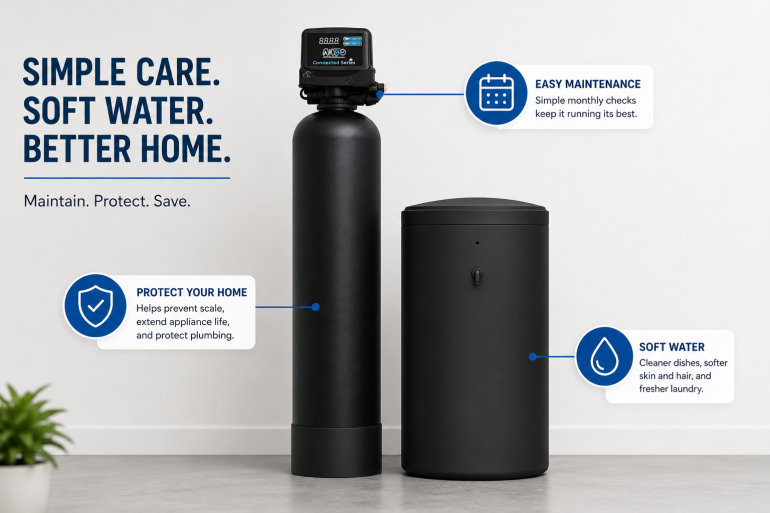
A water softener is a smart investment if your home has hard water. It removes scale-inducing minerals from your water supply, leading to healthier skin and hair, longer-lasting appliances, cleaner dishes, glassware, and fixtures, and other favorable outcomes. However, if you want your water softener to remain in good working order for as long as possible, you’ll need to stay on top of regular maintenance.
In this water softener maintenance guide, we share proactive and preventative steps to keep your system running at full efficiency, extend its lifespan, and reduce costly repairs. (Hint: The steps are easy to follow and shouldn’t take up too much time.)
How Do Water Softeners Work?
Before tackling maintenance tasks, it’s important to understand the basic mechanism behind water softeners. Water softeners are designed to remove dissolved calcium, magnesium, and other minerals that contribute to “hard water.” They work by running hard water through a resin bed of tiny beads coated with sodium ions. As water flows over the resin bed, the hardness-causing minerals in the water are replaced with sodium using an “ion exchange” process. The now-softened water exits the softener tank and flows throughout the house. The system later runs a regeneration cycle to flush out the wastewater and recharge the resin beads with salt from the brine reservoir. This regeneration process allows the beads to keep on capturing more hard-water minerals.
Benefits of Water Softener Maintenance and Care
Just like cars, certain appliances, and even the human body, water softeners need regular upkeep to perform at their best. But many homeowners don’t think much about water softener maintenance (if ever at all) until an issue arises. Water softeners aren’t “set it and forget it” appliances; they need thoughtful care and maintenance to keep running smoothly and efficiently. That said, here are three reasons why water softener maintenance matters more than you might think.
It helps protect your investment.
As you’re likely well aware, water softeners can be quite expensive. A basic whole-house model can cost hundreds or thousands of dollars, depending on its size, capacity, and other factors. Plus, there may be additional expenses for things like installation and salt refills. Considering this, you want to get the most out of your purchase, and staying on top of maintenance is key to achieving that. With normal maintenance, most water softeners should run well for 10 to 15 years, though higher-quality, better-maintained systems can last much longer. A neglected system, on the other hand, can fail within 3 to 5 years or sooner, meaning you might have to replace it far earlier than expected and risk losing money as a result.
It helps save you money on repair and replacement costs.
When a water softener is poorly maintained or not maintained at all, it typically uses more water, salt, and energy than usual to soften the same amount of water, translating into higher utility costs. Putting off maintenance can lead to other issues, such as salt bridges, sludge buildup, clogged valves, and resin bed fouling, which can put more strain on the system and cause premature damage. Seals and control valves may wear out faster, and blocks may develop in the venturi valve (a small component that controls salt flow). Replacing a control valve or resin, for instance, can cost hundreds of dollars or more. Regular upkeep of your water softener catches minor problems early or prevents them, saving you from potentially expensive repair and replacement costs.
It keeps your water soft.
The purpose of using a water softener is to prevent hard water issues. But unless you keep the system in good shape with regular maintenance, issues can develop that may disrupt the water softening process and expose you and your home’s plumbing and appliances to hard water. For instance, salt bridges may form a hard crust inside the brine tank. These crusts can form a solid layer of salt above the water, preventing it from dissolving properly. Similarly, salt mushing may create sludge that can clog the brine well by forming a wet, thick layer at the bottom of the tank. Both of these issues can severely interrupt the water softening process. Consequently, you may begin experiencing the very issues you were trying to prevent by using a water softener: spots on dishes, dull laundry, soap that won’t lather, damaged pipes and appliances, and other common hard water woes.
How to Maintain Your Water Softener for Optimal Performance and Longer Lifespan
Now that you know the importance of water softener maintenance, it is time to learn how to do it. The good news is that you don’t have to be a mechanical whiz to take care of your water softener. A few quick checks and cleanings can keep the system working at its best and maintain consistent water quality. Of course, every unit is different; some will hold up better than others. Ultimately, your owner’s manual is the best source for specific guidance on maintaining your exact water softener model, but these general maintenance tips can also be incredibly effective.
-
Check salt levels at least once a month.
One of the most important water softener maintenance tasks is ensuring the system never runs out of salt. Water softeners use salt to flush away hard water minerals and recharge the resin beads to prepare them to soften more water. So, at least once a month, check that there’s enough salt in the brine tank. To inspect water softener salt levels, locate the brine tank, lift the lid, and then note the salt level. There should be enough salt to cover any visible water. If salt levels are low, add salt to the tank until it reaches the level specified in the softener manual. If no guidance is provided and the tank doesn’t have a fill line, a general rule is to fill the brine tank at least halfway with salt and about 3 to 6 inches above the water level.
Running your softener with little or no salt can interrupt the regeneration cycle, which means your water won’t get softened properly, if at all. You also want to avoid piling the salt too high when refilling the tank, as more pressure can create hard crusts or bridging that may block water flow. Some modern water softeners feature an interface that displays your salt levels and notifies you when they are running low.
-
Use the right type of salt.
Speaking of salt, you should always make sure you’re using the right type for your system. Water softener salts come in different formats and vary in purity, effectiveness, and other factors, so ensure you choose the correct type when it’s time to refill the brine tank. Although some water softeners can run on multiple types of salt, check the manufacturer’s guide to see if your system requires a specific type.
There are three main types of salt a water softener might use:
- Rock salt (coarse salt) is widely available and relatively inexpensive, but often contains more impurities that may reduce softening efficiency and create buildup in the tank, requiring frequent cleaning.
- Solar salt is purer than rock salt and works well for moderately hard water. It leaves light deposits, reducing how often you need to clean the tank. It also strikes a balance between a high-quality water softener salt and one that’s budget-friendly.
- Evaporated salt is the purest you’ll find on the market, but it comes at a higher price. Because it dissolves quickly and leaves very little residue, it is less likely to form stubborn salt bridges that can clog the brine tank. It is also a great option for homes with very hard water.
The higher the purity of the salt you add to your water softener, the higher the upfront cost. A major upside is that your softener will perform more efficiently and require less maintenance. But consider using salt pellets since they dissolve more easily and cause less clumping. Another thing to note is that if your water contains iron, you should mix iron-removal salt with standard softener salt to help extend the system’s lifespan.
-
Check for salt bridging and mushing every month.
Salt bridges form when salt clumps together in a section of a water softener’s brine tank, generally due to high humidity or poor-quality salt. This layer of hardened salt prevents loose salt at the top of the tank from mixing with the water beneath to create a brine solution. When this happens, your water softener won’t be able to soften the water. To check for salt bridges, gently nudge the salt in the tank with a long broom handle or dowel. If it feels hollow, break it up. Pouring hot water over the salt can help loosen hardened buildup, making it easier to break up any solid layers that may have formed.
Also, keep an eye out for salt mush, a thick, cement-like sludge that forms at the base of the brine tank. This sludgy pile can cause the water to rise around it rather than mix in, clogging the brine well and preventing the system from regenerating. If you notice a large salt buildup in the tank, grab a broomstick or dowel again, use the handle to break it up, then scoop out the mush. You may dissolve the mush in hot water, then pour it back into the tank.
-
Clean the brine tank annually.
It’s also a good idea to clean the brine tank thoroughly at least once a year. Over time, salt bridges and mush, salt impurities, mineral sludge, and dirt can collect in the tank, clog the system, and lead to expensive repairs or system replacement. A yearly cleaning helps clear out this buildup and keeps the system running more smoothly. However, you may need to clean the tank more frequently if your home has well water or high humidity.
Follow these steps to clean your water softener brine tank by yourself:
- Shut off the incoming water valve and unplug the water softener.
- Dump out the water and any leftover salt, and remove the brine grid and set it aside.
- Add a few drops of dish soap and a splash of bleach to a bucket of warm water, then use a long-bristle brush or a non-abrasive sponge to scrub the inside of the tank with the soapy water.
- Rinse the tank thoroughly with clean water, ensuring all the soap is removed.
- Replace the brine grid and reconnect the tank to the water softener.
- Refill the salt and fresh water to the recommended levels.
- Let it sit for two hours, then turn on the water softener.
As always, be sure to consult your manufacturer’s manual for cleaning instructions specific to your water softener.
-
Clean the resin bed once a year.
The resin bed is the core component that strips hardness minerals from your water. However, iron, sediment, bacterial slime, chlorine, and other impurities can wear or coat the resin beds and reduce their ability to soften water effectively. Signs of a fouled resin bed include common hard water symptoms, such as soap scum on surfaces, scale buildup on fixtures, spotty dishes and glassware, and reduced water pressure. You may also notice a sudden spike in salt usage without an improvement in water quality. To prevent these issues, use a liquid resin cleaner once a year to flush out minerals and contaminants. Simply pour the recommended amount of cleaner into the brine tank tube and manually run a regeneration cycle. Doing so recharges the resin media beads so they can keep working efficiently and last longer. When cleaning no longer restores performance, consider calling a pro to replace the beads.
-
Inspect the softener for leaks, wear, and damage every month.
You should visually inspect your water softener once every month and have a full professional inspection every 12 to 18 months. Doing so helps catch issues that could otherwise go unnoticed and become much more difficult, destructive, and expensive to fix. A DIY inspection involves taking a quick walk around the unit, and checking for wet spots on the floor, holes or moisture around seals, O-rings, and gaskets, corrosion on valves, salt crust on fittings, or anything else that seems unusual. If you spot any signs of a leak, turn off the water supply to the system. If you have enough plumbing experience, you can fix the leak yourself. Otherwise, call a professional to handle it. In situations where you may be away from home for extended periods, a Smart Leak Detection and Auto Shutoff System should be in place to alert you to the first sign of a leak and automatically shut off the water supply to prevent further issues.
Learn more about how smart leak detectors work.
-
Clean the venturi assembly at least every six months.
The nozzle and venturi in a water softener create a suction to pull brine into the mineral tank during the regeneration cycle. If the assembly becomes clogged with sand, sediment, and dirt, the system stops working. Experts recommend inspecting and cleaning the valve at least twice a year or as specified by the manufacturer. Check your owner’s manual for more specific directions for your water softener model.
To clean the venturi assembly:
- Turn off and unplug the water softener.
- Switch the water softener’s bypass valve into the bypass position and ensure the system is in the soft water (service) cycle.
- Open the top lid of the water softener and remove it completely. Set it aside.
- Remove the nozzle and venturi disc, gasket, flow plugs, and internal components.
- Clean the parts with warm water and dish soap, then reassemble them once they are dry.
- Switch the bypass valve back to the service (soft water) position. Plug the softener in again.
Cleaning the nozzle and venturi requires great attention to detail. Failing to relieve water pressure before disassembling the valve could damage parts or cause injury. Plus, it’s easy to lose parts or reassemble them incorrectly. Therefore, the job may be best left to a professional.
-
Add a prefilter if the water contains sediment or heavy metals.
Similar to reverse osmosis membranes, certain elements in hard water can shorten the life of the resin bed. Things like sediment, chemicals, and heavy metals can foul the resins, impair their performance, or cause irreparable damage. Installing a prefilter helps trap particles before they reach the softener, reducing scale buildup and prolonging the system’s lifespan. This is especially important in homes with well water, rusty pipes, or sediment-contaminated water.
Learn how pre-filtration helps protect reverse osmosis membranes.
Signs Your Water Softener Needs Maintenance
While it’s a good idea to set reminders to check and maintain your water softener, sometimes maintenance needs to happen sooner than expected. If you notice any of the following signs, inspect the system and perform a full maintenance routine:
- Spotty or cloudy dishes, silverware, and glassware
- Soaps and shampoos that no longer lather well
- Dry, itchy skin and dull hair
- Stiffy, scratch laundry
- Less efficient water-using appliances like water heaters
- White, chalky buildup on kitchen and bathroom fixtures
- A decrease in water pressure
Learn how hard water damages your plumbing and appliances and how it can cause crunchy hair and dry skin.
When to Replace Your Water Softener
If your water softener has reached or surpassed the manufacturer’s suggested service life (about 10 to 15 years), is out of warranty, and no longer softens your water, replacing it may be more cost-effective than constantly repairing it. You should also consider a replacement if you notice rust on tanks and valves and other critical components, or if symptoms of hard water keep returning despite regular maintenance. Excessive salt or water usage or significant drops in water flow are also grounds for getting a new water softener. If you’re replacing an old water softener, consider upgrading to one that’s more efficient, such as those that regenerate on demand rather than on a fixed schedule. ENERGY STAR® certified models can reduce costs and save energy.
Final Thoughts
Taking good care of your water softener with regular maintenance helps ensure it works as it should for as long as possible. So, check the salt level and use the right type of salt, watch for salt bridges and mushes, and clean the brine tank at the intervals suggested in this guide or your owner’s manual. Also, make sure to look for leaks, clean the resin bed and venturi assembly, and install a prefilter if you use well water or your water appears cloudy or dirty. A few minutes each month helps protect your investment, prevent costly repairs, and keep your water consistently soft.
If you’re looking for a water softener that’s highly effective, built to last, and easy to maintain, SpringWell’s Water Softening Systems are excellent choices. For help finding the best system for your needs, call us at 800-589-5592 or message us via live chat.
